Ensuring the microbial safety and stability of multi-dose oral liquids like syrups is a non-negotiable aspect of pharmaceutical development. A robust preservative system is the first line of defense against contamination that can compromise patient safety and product integrity. This guide will help you master the Preservative Efficacy Test (PET) process for your oral liquid formulation, from understanding regulatory requirements and test methods to successfully passing acceptance criteria.

What is Preservative Efficacy Testing (PET) and Why is it Critical?
Preservative Efficacy Testing, also known as an Antimicrobial Effectiveness Test (AET), is a laboratory procedure designed to challenge a product’s preservative system. The primary goal of PET is to ensure patient safety by demonstrating that the formulation can effectively prevent the growth of or kill microorganisms that might be introduced during manufacturing or repeated use. For multi-dose aqueous oral formulations like syrups, which are susceptible to microbial contamination each time a dose is dispensed, this test is a critical regulatory requirement mandated by agencies like the FDA and EMA to prove the product will remain safe throughout its shelf life.
Key Pharmacopeial Methods: USP <51> vs. Ph. Eur. 5.1.3
The standards for this testing are outlined in global pharmacopeias. The two most commonly followed methods are the United States Pharmacopeia (USP) General Chapter <51>, “Antimicrobial Effectiveness Test,” and the European Pharmacopoeia (Ph. Eur.) Chapter 5.1.3, “Efficacy of Antimicrobial Preservation.” While both methods share the same fundamental purpose of challenging a product with a specific panel of microorganisms, they have slight differences in their acceptance criteria and testing categories. It is essential to know which regulatory market your product is intended for to ensure you follow the correct compendial method.
The Preservative Efficacy Test Procedure: A Step-by-Step Breakdown
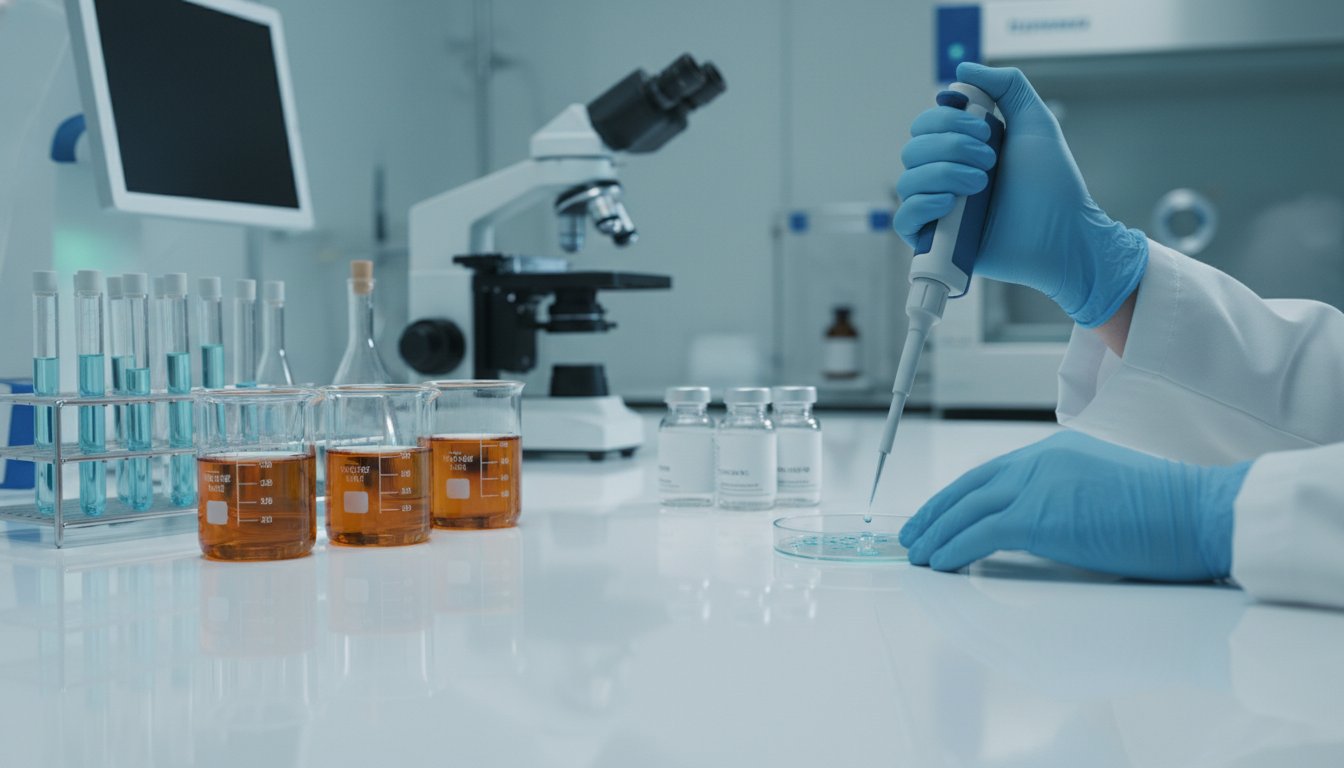
This section outlines the typical workflow in a microbiology lab to scientifically challenge your product. Understanding this process helps formulators appreciate how their choices directly impact the final test outcome.
Step 1: Selecting the Challenge Organisms
The test begins by introducing a panel of specific challenge organisms into separate samples of the product. These microbes are chosen because they are common contaminants and represent a broad range of potential threats. The standard compendial panel includes:
- Bacteria: Staphylococcus aureus, Pseudomonas aeruginosa, Escherichia coli
- Yeast & Mold: Candida albicans (a yeast), Aspergillus brasiliensis (a mold)
This specific panel is used because it includes Gram-positive and Gram-negative bacteria, yeast, and mold, providing a comprehensive challenge to the preservative system’s spectrum of activity.
Step 2: Inoculation, Incubation, and Sampling
A known quantity (a specific concentration) of each microorganism is added to individual product samples. These inoculated samples are then stored at a controlled temperature, typically 20-25°C, for a period of 28 days. To measure the effectiveness of the preservative over time, the samples are tested at specific intervals, most commonly at 0 hours (to establish a baseline), 7 days, 14 days, and 28 days. At each time point, the number of surviving microorganisms is counted.
Step 3: Interpreting Results: The Acceptance Criteria
Success or failure is determined by the “log reduction” in microbial count from the initial baseline. A 1-log reduction means the count has decreased by 90%, a 2-log reduction by 99%, and so on. For oral liquids (classified as Category 2 products in USP <51>), the criteria for bacteria are a minimum of 1.0 log reduction by 7 days and 3.0 log reduction by 14 days, with no further increase through day 28. For yeast and molds, the requirement is less stringent: there must be no increase from the initial count at any time point.
| Microorganism | 7 Days | 14 Days | 28 Days |
|---|---|---|---|
| Bacteria | Not less than 1.0 log reduction | Not less than 3.0 log reduction | No increase from 14 days |
| Yeast & Molds | No increase | No increase | No increase |
Formulation Strategy: How to Ensure Your Oral Liquid Passes PET
Passing PET is not about luck; it starts with a robust and well-considered formulation strategy. By considering the following factors during development, you can significantly increase your chances of success and avoid costly project delays.
Choosing the Right Preservative System
The selection of a preservative is a critical decision. Common preservatives for oral liquids include parabens (methylparaben, propylparaben), sorbates (potassium sorbate), and benzoates (sodium benzoate). The choice is influenced by several factors, including the formulation’s pH, compatibility with the active pharmaceutical ingredient (API) and other excipients, and potential impact on taste. In some cases, using preservatives in combination (e.g., methylparaben and propylparaben) can provide the necessary broad-spectrum activity against both bacteria and fungi.
Common Reasons for PET Failure in Syrups
Several factors can lead to a failed Preservative Efficacy Test. Understanding these common pitfalls can help you proactively design a more robust formulation. Key reasons include:
- High Water Activity (aw): High levels of “free” water in a formulation can create an environment where microbes thrive, overwhelming the preservative system.
- Incorrect Preservative Concentration: Using too low a concentration of the preservative will render it ineffective against the microbial challenge.
- Preservative Binding: The preservative may bind to other excipients (like suspending agents) or adsorb to the surface of the container, reducing its availability in the solution.
- Formulation pH: Many preservatives are only effective within a specific pH range. If the formulation’s pH drifts outside this range, the preservative can lose its efficacy.
What to Do After a PET Failure: A Troubleshooting Guide
A PET failure should not be seen as a dead end; instead, it provides valuable data to guide reformulation. Do not panic. The first step is to verify the test results and conduct a thorough review of the formulation and manufacturing process. Based on the findings, you may consider increasing the preservative concentration, evaluating alternative or combination preservatives, or adjusting the formulation’s pH. Any optimized formulation must then be re-tested to confirm its efficacy. Struggling with formulation? Our experts can help.
Frequently Asked Questions
When in the development process should PET be performed?
PET should be performed during formulation development on the final, market-ready formulation in its intended commercial packaging. It is also a key part of formal stability studies to ensure the preservative system remains effective throughout the product’s entire shelf life.
Can a product be “over-preserved” and are there risks?
Yes. While you need an effective concentration, using an excessive amount of preservative is not recommended. It can lead to potential patient safety issues, taste-masking challenges, and increased regulatory scrutiny. The goal is to use the minimum effective concentration that provides a robust margin of safety.
How does the product’s packaging (container/closure) impact preservative efficacy?
The container and closure system can significantly impact preservative efficacy. Some preservatives can be absorbed into plastic components, reducing their concentration in the liquid. It is crucial to conduct PET on the product stored in its final, intended packaging.
What is the difference between bacteriostatic and bactericidal?
A bacteriostatic agent prevents bacteria from reproducing, while a bactericidal agent actively kills them. In PET, the log reduction criteria for bacteria require a bactericidal effect, whereas the “no increase” criteria for fungi can be met with a fungistatic effect.
Is PET required for single-dose oral liquids?
Generally, PET is not required for single-dose, unit-of-use products because they are not intended for repeated use and therefore have a much lower risk of microbial contamination by the consumer.
Preservative Efficacy Testing is a fundamental pillar of developing safe and stable oral liquid medicines. By understanding the methodology, anticipating formulation challenges, and following a systematic approach to troubleshooting, you can navigate the process with confidence. A successful PET result is a critical milestone that validates your formulation and moves your product one step closer to regulatory approval and the patients who need it. Develop a robust, compliant oral liquid formulation with our expert support.