
Navigating the regulatory landscape for a new drug product can be daunting. For oral liquids like syrups and suspensions, the Chemistry, Manufacturing, and Controls (CMC) section of your submission is the foundation upon which regulatory approval is built. A well-organized, comprehensive CMC package demonstrates a deep understanding of your product and process, ensuring its quality, safety, and consistency. A weak one can lead to costly questions, delays, and potential rejection. This guide provides a step-by-step checklist to help you master the essential CMC requirements for your oral liquid drug submission and avoid those critical delays.
What is CMC and Why Is It Critical for Oral Liquids?
Chemistry, Manufacturing, and Controls (CMC) is the collection of data that describes the quality and purity of your drug substance and the characteristics of your drug product. Its primary goal is to prove to regulatory agencies like the FDA and EMA that you can consistently manufacture a product that is safe and effective. For oral liquids, CMC documentation carries unique challenges compared to solid dosage forms. You must rigorously control for factors like microbial contamination, taste-masking consistency, viscosity, and the stability of the active ingredient in a solution or suspension. All this information is typically organized within Module 3 of the Common Technical Document (CTD), the standard format for regulatory submissions.
Key Components of a CMC Dossier for Oral Liquids
A CMC dossier is broadly divided into two main areas: the drug substance (the Active Pharmaceutical Ingredient, or API) and the drug product (the final syrup or suspension). The drug substance section details the API’s identity, purity, physical characteristics, and manufacturing process. The drug product section, which is our focus here, describes the formulation, manufacturing, testing, and stability of the finished oral liquid that will be administered to patients. The core principle is demonstrating control over every step to ensure each batch meets the same high standards.
The Ultimate CMC Checklist: CTD Module 3 for Oral Liquids
This section follows the structure of the CTD Module 3, providing a practical checklist for compiling your submission. Use this as a guide to ensure you have covered all the critical information required by regulators.
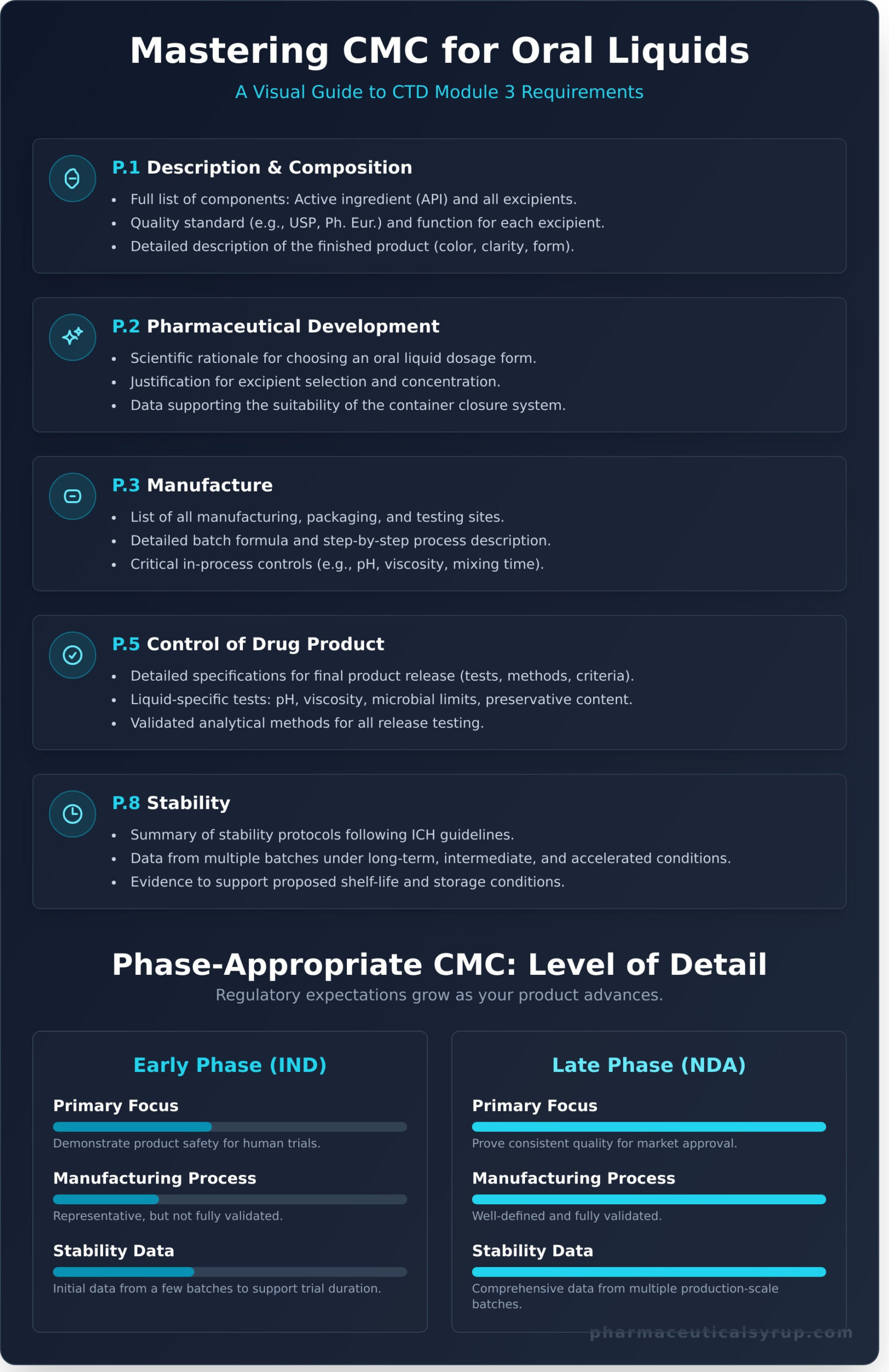
P.1: Description and Composition of the Drug Product
In this section, you must provide a complete and detailed breakdown of your oral liquid formulation. This includes a full list of all components, both the active ingredient and all excipients. For each excipient, you must state its quality standard (e.g., USP, Ph. Eur.) and its specific function within the formulation, such as a sweetener, preservative, solvent, or viscosity modifier. Finally, provide a clear description of the finished product’s appearance, including its color, clarity (for solutions), and physical form (e.g., “a clear, red, cherry-flavored syrup”).
P.2: Pharmaceutical Development
This is your opportunity to tell the story of your product’s development. You must explain the scientific rationale for choosing an oral liquid dosage form over other options. Justify the selection and concentration of each excipient, explaining how it contributes to the product’s performance, stability, and palatability. Detail the evolution of the manufacturing process, from early lab-scale batches to the final proposed commercial process. A critical part of this section for oral liquids is the discussion around the container closure system—explain why you selected a specific type of bottle, cap, and seal, and provide data showing it is suitable and does not interact with the product.
P.3: Manufacture
Here, you must provide a comprehensive overview of the manufacturing process. Start by listing all manufacturing, packaging, and testing sites, along with their responsibilities. Provide a detailed batch formula that includes quantities for a typical production batch size. The core of this section is a detailed description of the manufacturing process, often accompanied by a process flow diagram. This should clearly outline every step, from raw material dispensing and mixing to filling and packaging. Crucially, you must describe the in-process controls used to monitor the process, such as pH checks, viscosity measurements, and mixing time verifications, which ensure the batch is being made correctly.
P.5: Control of Drug Product (Batch Release Testing)
This section outlines the final quality control checks your oral liquid must pass before it can be released for distribution. You must provide the detailed specifications—a list of tests, analytical procedures, and acceptance criteria—for the finished product. For oral liquids, this will include standard tests for appearance, identity, assay (strength), and purity/impurities. It will also include tests specific to liquids, such as pH, viscosity, microbial limits (e.g., total aerobic microbial count, absence of objectionable organisms), and preservative content. You must also include reports that show you have properly validated the analytical methods used for this testing.
P.8: Stability
Stability data provides the evidence for your product’s proposed shelf-life and recommended storage conditions. You must summarize the stability study protocols, which should follow ICH guidelines (e.g., ICH Q1A), detailing the batch numbers, storage conditions (long-term, intermediate, and accelerated), and test intervals. Present the stability data in a clear format, showing that the product remains within its specifications over time. This section should also include results from stress testing and photostability studies. The data you present here is what you will use to justify the proposed shelf-life for your product. Compiling this data can be complex. Need help with your stability studies? See our services.
Phase-Appropriate CMC: What You Need and When
The level of detail required in your CMC documentation grows as your product moves through clinical development. What is sufficient for an early-phase trial is not enough for a final marketing application.
Early Phase (Phase 1 / IND)
For an Investigational New Drug (IND) application, the primary focus of the CMC section is safety. You need to demonstrate that the product is well-characterized and safe for initial human trials. The manufacturing process should be representative of how you will make future batches, but it does not need to be fully finalized or validated. Initial stability data from a few batches is typically sufficient to support the duration of the clinical trial.
Late Phase (Phase 3 / NDA)
By the time you are preparing a New Drug Application (NDA) for market approval, regulatory expectations are much higher. You must have a well-defined and validated manufacturing process that consistently produces a quality product. Comprehensive stability data from multiple production-scale batches is mandatory to support the commercial shelf-life. All analytical methods used for release and stability testing must be fully validated according to ICH guidelines.
| CMC Element | Early Phase (IND) | Late Phase (NDA) |
|---|---|---|
| Manufacturing Process | Representative process, not fully validated. | Locked, fully validated commercial process. |
| Analytical Methods | Qualified or phase-appropriately validated. | Fully validated per ICH guidelines. |
| Stability Data | Initial data to support trial duration. | Comprehensive data on primary batches to support shelf-life. |
| Specifications | Initial specifications based on available data. | Finalized commercial release specifications. |
Avoid Common Pitfalls in Oral Liquid CMC Submissions
Even with a checklist, several common mistakes can trigger regulatory questions and delay your approval. Being aware of these pitfalls can help you prepare a more robust submission:
- Inadequate Justification for Preservatives: Failing to provide data (e.g., Preservative Efficacy Testing) that proves your chosen preservative system is effective throughout the product’s shelf life.
- Poor Control Over Physical Attributes: For suspensions, not having sufficient control over particle size and potential for caking. For all liquids, not adequately defining and controlling viscosity.
- Insufficient Stability Data: This is a major red flag. Not providing enough data, especially on “in-use” stability after a bottle is opened, can lead to significant delays.
- Failing to Validate Analytical Methods: Claiming a method can detect impurities without providing full validation data is a common reason for deficiency letters.
Navigating these complexities requires specialized expertise. Partner with an expert CDMO to ensure a flawless submission.
Frequently Asked Questions
What is the difference in CMC documentation for an oral solution vs. an oral suspension?
While much of the documentation is similar, a suspension requires additional data related to the solid particles. This includes control of API particle size distribution, testing for dissolution, and stability studies that specifically look for caking (irreversible settling) or changes in redispersibility over time.
What are Critical Quality Attributes (CQAs) for a pharmaceutical syrup?
CQAs are physical, chemical, biological, or microbiological attributes that must be controlled to ensure the desired product quality. For a syrup, CQAs often include assay (strength), pH, viscosity, preservative content, microbial limits, and the concentration of specific impurities.
How much stability data is required for an IND submission?
For an IND, you generally need enough stability data to demonstrate the product is stable for the duration of the planned Phase 1 clinical trial. This might be 3-6 months of accelerated and long-term data on at least one representative batch.
Do I need to include CMC information for the excipients?
Yes, you must identify each excipient, state its quality grade (e.g., USP), and confirm it is suitable for pharmaceutical use. You may often reference the excipient supplier’s Drug Master File (DMF) for more detailed manufacturing information.
What is the role of a Drug Master File (DMF) in CMC documentation?
A Drug Master File (DMF) is a confidential submission to the regulatory agency that contains detailed information about the manufacturing of an API or excipient. By referencing a DMF in your application, you can include the necessary information without the supplier having to disclose proprietary details directly to you.
Preparing a robust CMC package is a critical and non-negotiable step on the path to regulatory approval. By following a structured approach, understanding the unique requirements for oral liquids, and anticipating common pitfalls, you can build a submission that demonstrates quality and control. This not only streamlines the review process but also lays the groundwork for a successful commercial product. Ensure your CMC submission is right the first time. Contact our regulatory experts.