
Selecting a Contract Development and Manufacturing Organization (CDMO) is one of the most consequential decisions your pharmaceutical company will make. This isn’t just a vendor relationship; it’s a long-term strategic partnership that can determine the success or failure of your product. A bad fit can lead to catastrophic delays, budget overruns, and quality issues that put your entire project at risk. While many guides focus on positive attributes, knowing what to avoid is often more critical. This guide is built to help you spot the crucial warning signs that others don’t mention, protecting your project from day one.
Why Spotting Red Flags is More Important Than Ticking Boxes
Choosing a CDMO is a critical, long-term partnership that goes far beyond a simple service agreement. A mismatch can lead to more than just financial loss; it can compromise your intellectual property, derail your regulatory timeline, and damage your company’s reputation. Instead of just looking for a partner who ticks all the right boxes, it’s essential to proactively identify potential deal-breakers. This proactive approach helps you filter out unsuitable candidates early, allowing you to focus your due diligence on partners who are truly aligned with your project’s needs and your company’s values.
Key Takeaways: CDMO Red Flags Checklist
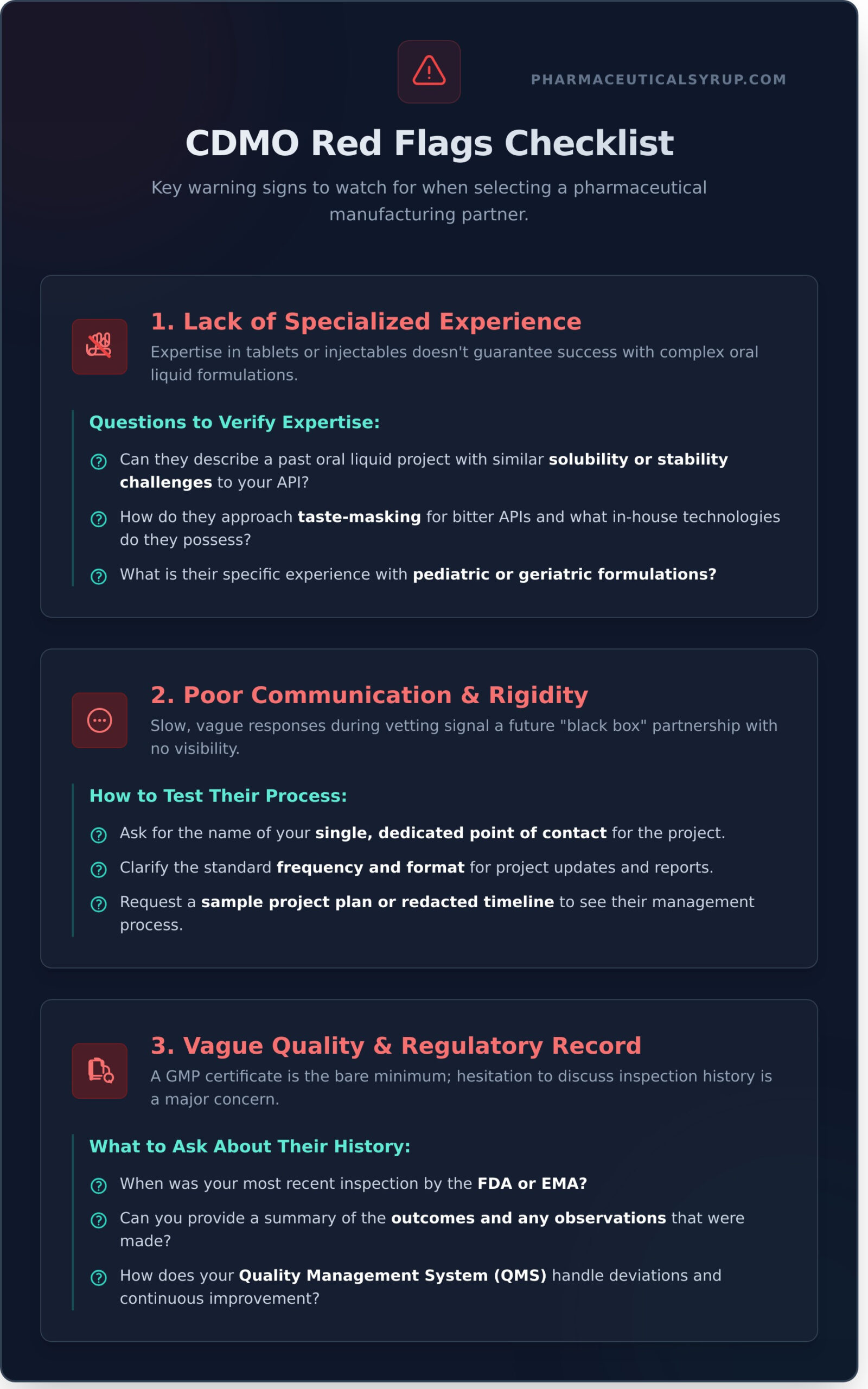
- Lack of specialized experience: A history in solid-dose manufacturing doesn’t translate to expertise in your specific dosage form, like oral liquids.
- Poor communication: Vague, slow, or infrequent communication during the vetting process is a preview of a difficult partnership.
- Vague quality and regulatory history: Hesitation to discuss inspection outcomes or quality systems is a major warning sign.
- Mismatched scale: A CDMO focused on large-scale commercial runs may not give your early-phase project the attention it needs.
- Unclear project management: A lack of a dedicated project manager or a transparent process often leads to hidden costs and delays.
Red Flag #1: Lack of Specialized Experience in Oral Liquids
Not all CDMO experience is created equal, and this is especially true in the world of pharmaceuticals. A CDMO might boast decades of experience, but if that experience is primarily in tablets or injectables, they may be unprepared for the unique challenges of oral syrups. These formulations require specific expertise in areas like taste-masking bitter APIs, ensuring drug solubility and stability in a liquid matrix, and developing effective preservative systems.
Why general pharma experience isn’t enough
The science behind oral liquids is fundamentally different from that of solid dosage forms. Formulation challenges involve complex fluid dynamics, rheology, and chemistry that aren’t factors in pill manufacturing. Furthermore, specialized populations like children or the elderly often rely on liquid medicines, requiring deep expertise in pediatric and geriatric formulations to ensure proper dosing and palatability. The manufacturing, filling, and packaging equipment for liquids is also highly specialized and distinct from that used for other drug types.
Questions to ask to verify their expertise
To cut through the marketing claims and assess true expertise, ask direct, evidence-based questions:
- “Can you describe a past project involving an oral liquid with similar solubility or stability challenges to our API?”
- “How do you approach taste-masking for intensely bitter APIs, and what technologies do you have in-house?”
- “What is your specific experience with developing pediatric or geriatric formulations, including any work with novel flavoring or excipient systems?”
Red Flag #2: Poor Communication & Inflexible Processes
The communication patterns you observe during the initial vetting process are often a reliable predictor of the future partnership’s quality. If a potential CDMO is slow to respond, provides vague answers, or seems disorganized, imagine how those issues will be amplified once a complex project is underway. A lack of transparency is a significant warning sign that you could be left in the dark at critical moments.
The ‘black box’ problem: when you lose visibility
A “black box” CDMO is one where you provide your API and requirements, and then receive sporadic, high-level updates without any real insight into the process. This lack of visibility is risky. Pharmaceutical development is rarely linear; unexpected challenges in formulation or scale-up are common. You need a flexible partner who can collaborate on solutions, not a rigid vendor that treats every deviation as a new contract negotiation. The relationship should feel like a true collaboration, with your team and theirs working as a single unit toward a common goal.
How to test their communication and project management
Before signing any contracts, rigorously test their processes:
- Ask directly: “Who will be our single, dedicated point of contact for the entire project?”
- Clarify expectations: “What is the standard frequency and format for project updates and progress reports?”
- Request evidence: “Could you provide a sample project plan or a redacted timeline from a similar project to demonstrate your management process?”
Red Flag #3: Vague Quality & Regulatory Track Record
A current Good Manufacturing Practice (GMP) certificate is the absolute bare minimum for entry into the market; it is not, by itself, a mark of excellence. The true measure of a CDMO’s quality lies in its culture, its systems, and its history of regulatory compliance. A partner’s track record with bodies like the FDA and EMA is a direct reflection of their commitment to quality.
Digging deeper than the GMP certification
Go beyond the certificate and inquire about the substance of their quality systems. Ask about their experience with different major regulatory bodies, as requirements can vary significantly. A strong CDMO will be able to speak fluently about their Quality Management System (QMS), their process for handling deviations, and their approach to continuous improvement. Any hesitation, defensiveness, or inability to provide clear answers to these questions is a clear red flag.
What to ask about their inspection history
A high-quality, confident CDMO will be transparent about its regulatory history. They understand that inspections are part of the business and will be prepared to discuss them openly. Key questions to ask include:
- “When was your most recent inspection by the FDA or EMA?”
- “Can you provide a summary of the outcomes and any observations that were made?”
A partner who is proud of their operations will have no issue discussing their compliance record. A transparent approach to quality is non-negotiable, and it is the foundation of a successful partnership. To understand what a proactive quality culture looks like, you can learn about our commitment to quality assurance.
Beyond the Red Flags: Making Your Final Decision
After thoroughly vetting potential partners and eliminating those with clear red flags, you should have a shortlist of highly qualified CDMOs. The final step is to confirm the fit. Whenever possible, conduct site audits—either in-person or virtually—to see their facilities and meet the team you would be working with. Ultimately, trust your team’s collective assessment. A successful partnership relies as much on cultural fit, clear communication, and mutual trust as it does on technical capabilities.
Frequently Asked Questions
What is the difference between a CMO and a CDMO?
A Contract Manufacturing Organization (CMO) primarily focuses on the manufacturing of a drug that has already been developed. A Contract Development and Manufacturing Organization (CDMO) provides a much broader range of services, including formulation development, analytical testing, and process scale-up, in addition to commercial manufacturing.
How early should I start the CDMO selection process?
You should begin the search process as early as possible, ideally 12-18 months before you anticipate needing development or manufacturing services to begin. This allows ample time for thorough due diligence, negotiation, and the tech transfer process without rushing.
What are the key components of a CDMO Quality Agreement?
A Quality Agreement is a legal document that defines the specific quality-related roles and responsibilities of both your company and the CDMO. Key components include procedures for handling deviations, change control, batch release, audits, and regulatory reporting.
Is a local CDMO always better than an overseas one?
Not necessarily. While a local partner can offer logistical convenience and easier site access, the most important factors are expertise, quality, and capability. A specialized overseas CDMO with a proven track record for your specific product type is often a better choice than a non-specialized local option.
How can I protect my intellectual property (IP) when working with a CDMO?
Protecting your IP starts with a robust non-disclosure agreement (NDA) before any sensitive information is shared. The main service agreement should also contain clear clauses defining ownership of pre-existing and newly developed IP, as well as confidentiality obligations.
Choosing the right CDMO is a decision that will shape the future of your product. By looking for these critical red flags and asking the right questions, you can build a strong, transparent, and productive partnership. If your project involves the complex world of oral liquid formulations, you need a partner with specialized expertise. Discuss your syrup formulation project with our experts.