Developing effective medications for older adults involves more than just ensuring API efficacy and stability. The palatability of a drug—its overall acceptability in terms of taste, smell, and mouthfeel—is a critical factor that directly influences patient adherence and, ultimately, therapeutic outcomes. For formulators, understanding the unique challenges of the geriatric population is the first step toward creating a successful and well-accepted product. This guide explores the key considerations and proven strategies for improving the taste of medicines for older adults.
Why Palatability is a Critical Factor in Geriatric Medicine
For many older patients, particularly those managing chronic conditions, medication is a daily reality. If that experience is unpleasant, adherence can drop significantly. The direct link between poor taste and medication non-adherence is well-documented, often leading to treatment failure, disease progression, and increased healthcare costs. Therefore, formulators must treat palatability as a key component of drug design from the earliest stages, not as a final-stage problem to be solved.
Physiological Changes Affecting Taste in Older Adults
The aging process brings several physiological changes that alter how individuals perceive taste and flavor, making formulation for this demographic uniquely challenging:
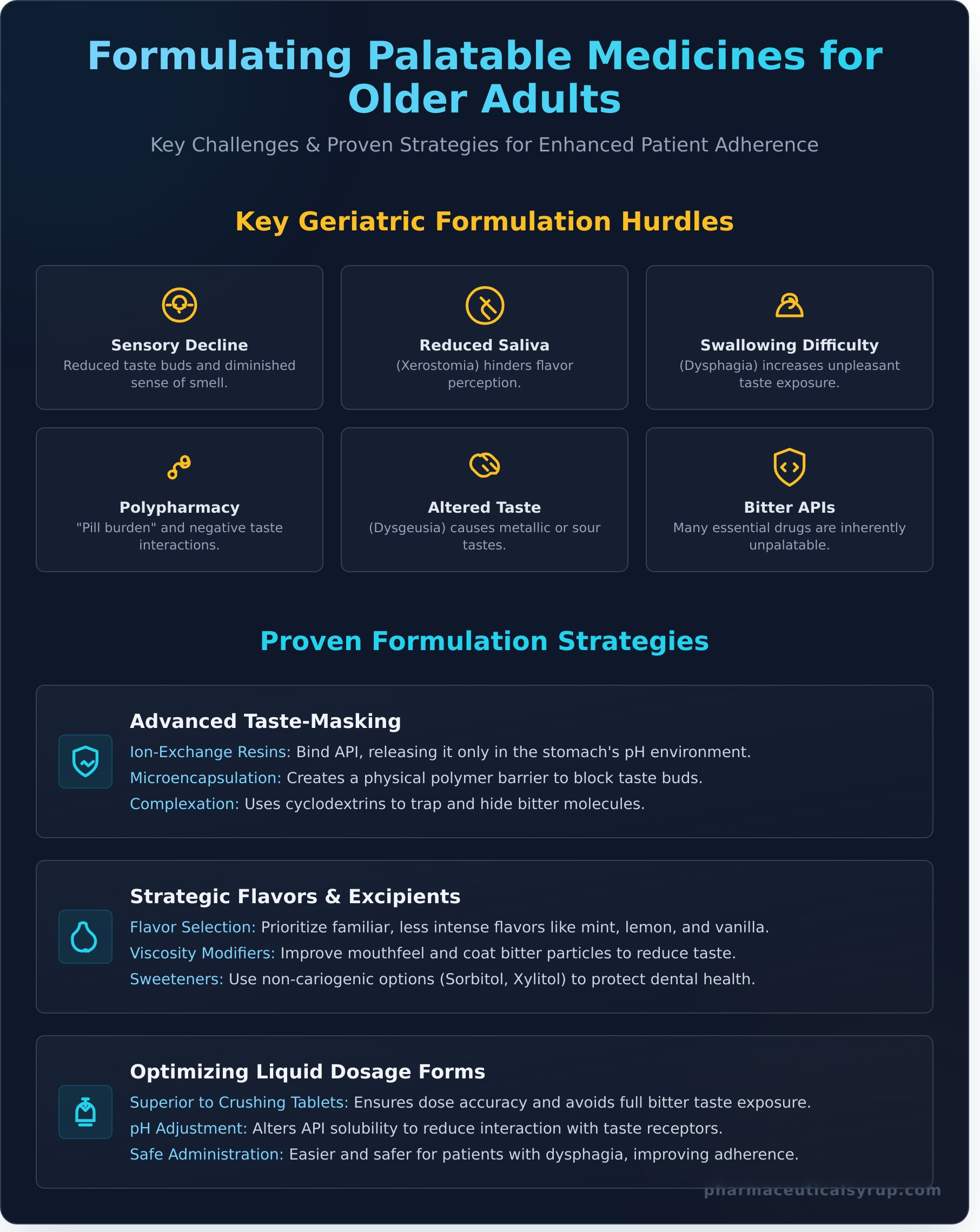
- Sensory Decline: As people age, there is a natural decline in the number and sensitivity of taste buds, as well as a diminished sense of smell. This can make it harder to perceive subtle, pleasant flavors and easier to be overwhelmed by strong, bitter, or metallic notes.
- Reduced Saliva Production: Xerostomia, or dry mouth, is common in older adults, often as a side effect of medication. Saliva is essential for dissolving food and drug particles to be detected by taste receptors, so its absence can significantly blunt flavor perception.
- Swallowing Difficulties: Dysphagia, or difficulty swallowing, affects a large percentage of the geriatric population. This not only makes solid dosage forms like large tablets problematic but also means that liquid formulations may linger in the mouth longer, increasing the exposure time to unpleasant tastes.
The Impact of Polypharmacy and Chronic Conditions
Beyond natural aging, the health status of many older adults adds another layer of complexity to formulation:
- Polypharmacy: It is common for geriatric patients to take multiple medications simultaneously. This can create unpleasant taste interactions or lead to a cumulative “pill burden” that makes any additional medication feel unwelcome.
- Altered Taste Perception: Certain chronic conditions and their treatments (such as chemotherapy) can cause dysgeusia, a distortion of the sense of taste, making foods and medicines taste metallic, sour, or rancid.
- Bitter APIs: Many active pharmaceutical ingredients essential for treating conditions common in the elderly—such as cardiovascular drugs, antibiotics, and analgesics—are inherently bitter, requiring sophisticated taste-masking strategies.
Effective Formulation Strategies to Enhance Palatability
Successfully formulating for older adults requires moving beyond simply adding sweeteners. A holistic approach that considers taste, mouthfeel, and aroma is necessary for creating a genuinely palatable product. Critically, all chosen excipients must have a strong safety profile and low potential for interaction with other medications.
Example 1: Advanced Taste-Masking Technologies
For APIs with strong, unpleasant tastes, advanced technologies are often required to prevent the drug molecule from interacting with taste receptors. Scientific studies have validated several effective methods:
- Ion-Exchange Resins: This technique involves binding the charged drug particle to an oppositely charged resin. This complex is too large to be detected by taste buds and only releases the API in the specific pH environment of the stomach or intestine.
- Microencapsulation: By creating a physical barrier around the API with a tasteless coating (often a polymer), microencapsulation effectively isolates the bitter taste from the patient’s palate until it is absorbed.
- Complexation with Cyclodextrins: These doughnut-shaped molecules can trap bitter API molecules within their central cavity, masking their taste without chemically altering the drug itself.
Example 2: Strategic Use of Flavors and Excipients
The careful selection of flavors and functional excipients plays a crucial role in the final product’s acceptability:
- Flavor Selection: Research indicates that older adults often prefer familiar, less intense flavors. Tastes like mint, lemon, butterscotch, and vanilla are often more successful than overly sweet or novel fruit flavors.
- Viscosity Modifiers: Using excipients like xanthan gum or carboxymethylcellulose can increase the viscosity of a liquid formulation. This not only improves mouthfeel but can also help coat bitter particles, reducing their contact with taste buds.
- Sweeteners: While sweeteners are essential, the choice is important. Non-cariogenic sweeteners like sorbitol, xylitol, or sucralose are often preferred to avoid impacting dental health or blood sugar levels.
Example 3: Optimizing the Liquid Dosage Form
The dosage form itself is a key tool in improving palatability and ensuring safe administration for patients with dysphagia.
- Superiority Over Solid Doses: Syrups and oral solutions are often superior to crushing tablets, a practice that can lead to dose inaccuracies, stability issues, and full exposure to the API’s bitter taste.
- pH and Solubility Adjustments: Carefully adjusting the pH of a liquid formulation can alter the solubility of an API, which in turn can reduce its interaction with taste receptors and minimize unpleasant sensations.
- Dose Accuracy and Administration: A well-formulated liquid ensures consistent dose accuracy and is far easier for patients with swallowing difficulties to administer, improving both safety and adherence. If you are struggling to balance these factors for a challenging API, our team can help. Explore our formulation services.
Partnering with a CDMO for Geriatric Formulation Success
The complexities of geriatric drug development mean that partnering with a specialized Contract Development and Manufacturing Organization (CDMO) can be a strategic advantage. This allows pharmaceutical companies to leverage specialized expertise and advanced technologies without the need for significant capital investment in-house. A knowledgeable partner can help accelerate development timelines and navigate the unique regulatory considerations for drugs targeted at geriatric populations.
What to Look for in a Formulation Partner
When selecting a CDMO for your geriatric product, consider the following criteria:
- Demonstrated Experience: Look for a partner with a proven track record of developing formulations for geriatric and other special populations.
- Advanced Technology Portfolio: Ensure they have a robust suite of taste-masking technologies and the analytical capabilities to support them.
- Integrated Services: An ideal partner offers end-to-end services, from early-stage formulation and development through to cGMP scale-up and commercial manufacturing.
- Regulatory and Quality Systems: A strong commitment to quality, evidenced by robust cGMP compliance and experience with global regulatory submissions, is non-negotiable.
Frequently Asked Questions
What are the most common taste complaints from geriatric patients?
The most frequent complaints involve bitterness and metallic tastes, which are common characteristics of many APIs. Other issues include chemical or artificial aftertastes and textures that are too gritty or thick.
How does dysphagia impact the choice of a dosage form?
Dysphagia makes swallowing solid forms like tablets and capsules difficult or dangerous. Liquid formulations, such as syrups or oral solutions with appropriate viscosity, are the preferred alternative as they are easier to swallow and reduce the risk of choking.
Are natural or artificial sweeteners better for geriatric medicines?
Both can be effective. The choice often depends on the specific API and formulation requirements. Artificial, high-intensity sweeteners are useful because a very small amount is needed. However, some patients prefer the taste profile of natural sweeteners like sorbitol, which can also contribute to the product’s texture.
What is the role of ‘mouthfeel’ in the palatability of liquid medicines?
Mouthfeel refers to the physical sensations a product creates in the mouth, including texture, viscosity, and coating properties. A smooth, pleasant mouthfeel can significantly improve overall acceptability, even if the taste is not perfect, while a gritty or chalky texture can lead to rejection.
Can you mask a strong metallic taste in an oral syrup?
Yes, masking a metallic taste is possible but challenging. It often requires a multi-pronged approach using specific flavors (like mint or citrus), sweeteners, and advanced technologies like chelation or complexation to bind the metallic ions and prevent them from being detected.
Creating a palatable medicine for older adults is a complex but achievable goal that pays dividends in patient health and product success. It requires a deep understanding of geriatric physiology, a strategic approach to formulation, and access to the right technologies. By prioritizing palatability, formulators can develop products that are not only effective but also willingly accepted by the patients who need them most. If your team is facing a geriatric formulation challenge, we have the expertise to help. Contact our formulation experts to discuss your geriatric drug development project. With decades of experience in oral liquid formulations and a state-of-the-art cGMP facility, we specialize in solving the toughest taste-masking challenges.