Developing a successful pharmaceutical syrup is a complex science that blends chemistry, patient compliance, and regulatory precision. A well-formulated syrup must not only deliver a stable and effective dose of the active pharmaceutical ingredient (API) but also be palatable enough for consistent patient use. This guide will walk you through the complete process of creating a stable and effective oral syrup, from selecting the right ingredients to overcoming key formulation challenges.
Key Takeaways
- A pharmaceutical syrup is a viscous, sugar-based oral liquid ideal for patients who have difficulty swallowing tablets, such as children and the elderly.
- Formulation involves a careful balance of key ingredients: the API, vehicles, sweeteners, preservatives, and stabilizers.
- The development process follows a structured workflow, including pre-formulation studies, excipient selection, overcoming common hurdles like solubility and taste-masking, and rigorous stability testing.
- Addressing challenges like microbial stability and physical degradation is critical for ensuring product safety, efficacy, and shelf life.
What is a Pharmaceutical Syrup? Core Concepts
In pharmaceutical terms, a syrup is a concentrated, viscous oral liquid that contains a high proportion of sugar, typically sucrose, dissolved in purified water. This simple base serves as an excellent vehicle for delivering medicinal substances. The key advantages of syrups over solid dosage forms like tablets or capsules are significant. Their liquid nature makes them easy to swallow, which is a critical benefit for pediatric and geriatric patients who often struggle with solid medications. Furthermore, syrups allow for flexible and precise dosing, as the volume can be easily adjusted to suit a patient’s specific weight or age, a feature that is difficult to achieve with fixed-dose tablets.
Types of Syrups Used in Pharmaceuticals
Pharmaceutical syrups can be categorized based on their function and composition:
- Simple Syrups: These are the most basic type, consisting of a concentrated solution of sugar (like sucrose) in purified water. They primarily act as a sweetening agent and a vehicle for other ingredients.
- Medicated Syrups: These formulations contain one or more active pharmaceutical ingredients (APIs). The syrup base helps to deliver the drug in a stable, palatable form. Most cough and cold remedies are examples of medicated syrups.
- Flavored Syrups: These are non-medicated syrups that contain various aromatic and flavoring agents. Their primary purpose is to serve as a pleasant-tasting vehicle for extemporaneous preparations or to mask the unpleasant taste of a separately added drug.
| Dosage Form | Description | Key Advantage | Key Disadvantage |
|---|---|---|---|
| Syrup | Drug is completely dissolved in a high-sugar aqueous solution. | Excellent taste-masking; no shaking required. | Not suitable for drugs with poor water solubility. |
| Suspension | Insoluble solid drug particles are dispersed in a liquid vehicle. | Can deliver water-insoluble drugs. | Requires shaking to ensure dose uniformity; potential for caking. |
| Elixir | Drug is dissolved in a hydroalcoholic (water and alcohol) solution. | Can dissolve drugs that are insoluble in water alone. | Alcohol content may be unsuitable for certain patient groups (e.g., children). |
The Building Blocks: Key Ingredients in Syrup Formulation
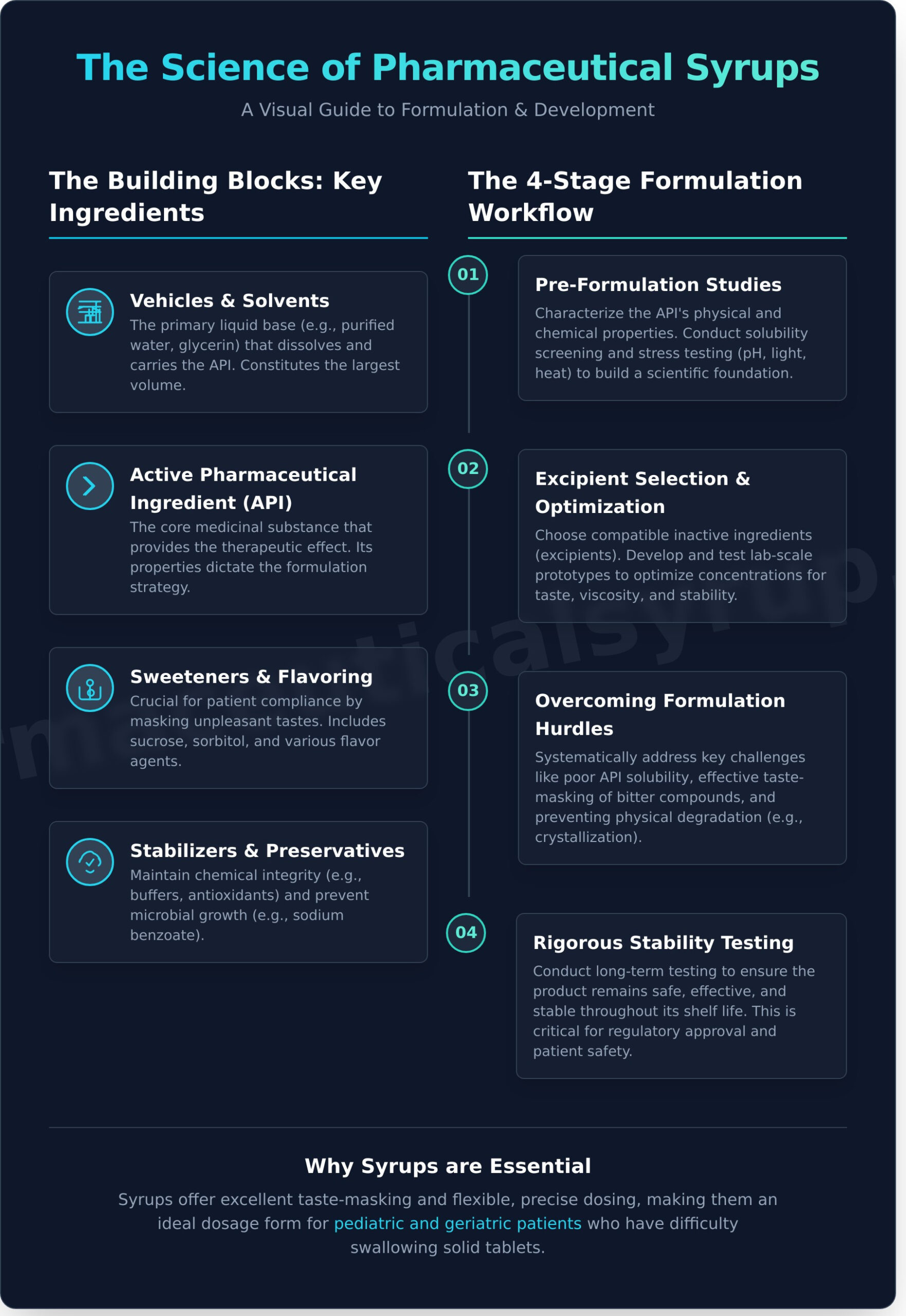
Every component in a syrup formulation plays a critical role in the final product’s stability, efficacy, and patient acceptability. Balancing these ingredients is the core of formulation science, ensuring that each element works in harmony to produce a safe and effective medicine.
Active Pharmaceutical Ingredient (API)
The API is the drug substance that provides the intended therapeutic effect. Its inherent physicochemical properties, such as solubility, stability in solution, and taste profile, are the most critical factors that dictate the entire formulation strategy. A successful formulation must maintain the API in a stable, dissolved state throughout the product’s shelf life.
Vehicles and Solvents
The primary liquid base of a syrup is its vehicle, which is typically purified water. Water is the universal solvent, but sometimes it is not enough to dissolve the API. In such cases, co-solvents like glycerin, sorbitol, or propylene glycol may be used to enhance the API’s solubility. These components make up the bulk of the syrup’s volume and form the foundation of the formulation.
Sweeteners and Flavoring Agents
Palatability is paramount for patient compliance, especially in pediatric medicine. Sucrose is the traditional sweetener, which not only provides a pleasant taste but also contributes to the syrup’s viscosity and can help preserve it at high concentrations. For diabetic patients or dental formulations, sugar-free options like sorbitol, xylitol, or artificial sweeteners (e.g., sucralose) are used. Flavoring agents are then added to complement the sweetness and effectively mask any unpleasant aftertaste from the API.
Preservatives and Stabilizers
Syrups, with their high water and sugar content, can be susceptible to microbial growth. To prevent this, preservatives such as sodium benzoate, potassium sorbate, or parabens are essential. Additionally, stabilizers are used to maintain the chemical integrity of the API. Antioxidants like ascorbic acid or sodium metabisulfite can prevent degradation from oxidation, while buffers are used to maintain a stable pH level, which is often crucial for the API’s solubility and stability.
The Formulation Development Process: A 4-Stage Workflow
A systematic and logical approach is essential for developing a robust and compliant syrup formulation. This process ensures that the final product is safe, effective, and manufacturable at scale. Each stage builds upon the previous one, progressing from initial lab bench experiments to pilot-scale batches ready for clinical trials.
Stage 1: Pre-Formulation Studies
Before any formulation begins, the API must be thoroughly understood. Pre-formulation studies involve characterizing the API’s key physical and chemical properties. This includes conducting solubility screening in various solvent systems to find the ideal vehicle, as well as assessing the API’s intrinsic stability under stress conditions like varying pH, light exposure, and heat. The data gathered here forms the scientific foundation for all subsequent development decisions.
Stage 2: Excipient Selection and Optimization
With a deep understanding of the API, the next step is to select compatible excipients—the inactive ingredients. This involves choosing sweeteners, preservatives, and stabilizers that will not negatively interact with the API. Formulators then develop and test multiple prototype formulations at a small laboratory scale. The goal is to optimize the concentrations of each excipient to achieve the desired taste, viscosity, appearance, and, most importantly, stability.
Stage 3: Overcoming Common Formulation Hurdles
During development, formulators often face several challenges that require expert problem-solving:
- API Solubility: If the API has poor water solubility, techniques like using co-solvents, pH adjustment, or complexing agents may be required to enhance its dissolution in the vehicle.
- Taste-Masking: This is an art as much as a science. It often involves combining multiple sweeteners and carefully selected flavoring agents to effectively cover any bitter or unpleasant taste of the API.
- Microbial Stability: Selecting the right preservative system is crucial. The chosen preservative must be effective against a broad spectrum of microorganisms without compromising the stability of the API.
- Physical Stability: Over time, issues like crystallization of the API or sugar can occur. Another common problem is “cap locking,” where sugar crystallizes on the bottle threads, sealing the cap shut. These issues are addressed by optimizing the levels of sucrose and humectants like sorbitol.
Stage 4: Stability Testing and Regulatory Preparation
Once a lead formulation is identified, it must undergo rigorous stability testing according to ICH (International Council for Harmonisation) guidelines. These studies are conducted under various temperature and humidity conditions to determine the product’s shelf life and appropriate storage conditions. Alongside this, robust analytical methods are developed to test the syrup’s quality, potency, and purity over time. All of this data is compiled into the Chemistry, Manufacturing, and Controls (CMC) section of the regulatory submission. If your team needs support with this critical stage, you can Explore our analytical services.
Frequently Asked Questions
What is the main difference between a syrup and a suspension?
The primary difference lies in the state of the API. In a syrup, the API is completely dissolved in the liquid vehicle, creating a clear solution. In a suspension, the API consists of fine, insoluble solid particles that are dispersed (not dissolved) throughout the liquid, requiring the patient to shake the bottle before use.
Why is sucrose the most common sugar used in syrup formulations?
Sucrose is preferred for several reasons: it is highly soluble in water, provides a very pleasant taste, and at high concentrations (typically 60-85%), it imparts viscosity and acts as a preservative by reducing the free water available for microbial growth.
How do you choose the right preservative for an oral syrup?
The choice of preservative depends on the syrup’s pH, its ingredients, and the target microbial contaminants. The preservative must be effective at the formulation’s pH, be compatible with the API and other excipients, and have a good safety profile for the intended patient population.
What is ‘cap locking’ and how can it be prevented in syrup formulation?
Cap locking is a physical instability issue where sugar from the syrup crystallizes on the threads of the bottle neck, effectively gluing the cap shut. It can be prevented by optimizing the formulation, often by replacing a portion of the sucrose with non-crystallizing substances like sorbitol, glycerin, or corn syrup.
What are the critical quality attributes (CQAs) of a pharmaceutical syrup?
CQAs are the physical, chemical, and biological properties that must be controlled to ensure product quality. For a syrup, key CQAs include API concentration (assay), pH, viscosity, microbial limits, taste, appearance (color and clarity), and the absence of degradation products.
Navigating the complexities of oral liquid formulation requires deep expertise and state-of-the-art facilities. From solving difficult solubility challenges to perfecting a taste profile for patient compliance, every step demands precision. Our team of experienced formulation scientists specializes in oral liquids and operates in GMP-compliant laboratories, with a proven track record in developing robust and scalable syrup formulations. If you are ready to bring your project to life, Partner with us to develop your next oral liquid formulation.