You’ve perfected your pharmaceutical syrup formulation in the lab. The stability data is solid, the taste profile is excellent, and the active pharmaceutical ingredient (API) is perfectly solubilized. Now comes the most critical transition: moving from a lab-scale beaker to a commercial-scale manufacturing vessel. This process, known as scale-up, is far more complex than simply using a bigger tank. It introduces a host of challenges that can impact product quality, consistency, and regulatory approval. Mastering this transition is essential for a successful product launch.
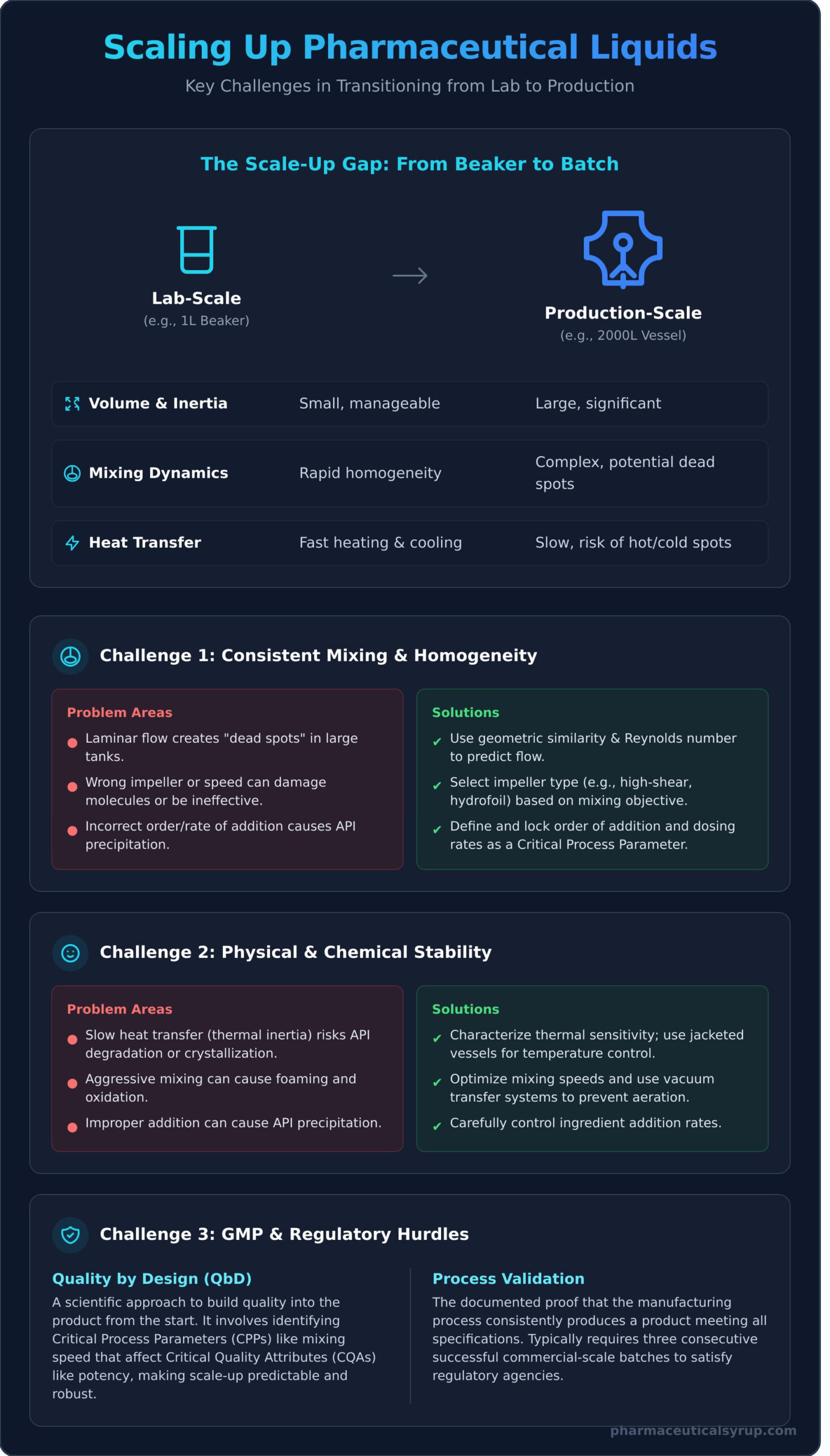
This guide will walk you through the most common challenges in scaling up liquid manufacturing, providing practical solutions to ensure your process is robust, repeatable, and ready for Good Manufacturing Practice (GMP) production.
From Beaker to Batch: Why Scaling Liquid Manufacturing is Complex
Success on the benchtop is a crucial first step, but it doesn’t automatically guarantee success in a 2,000-liter production vessel. As you increase batch size, the fundamental physics of the process change. A key difference is the surface-area-to-volume ratio, which decreases significantly at scale. This impacts critical parameters like heating, cooling, and mixing. The ultimate goal of scale-up is to develop a robust and validated process that consistently produces a product meeting all quality specifications, batch after batch.
Understanding the differences between the two environments is the first step in planning a successful scale-up strategy.
| Parameter | Lab-Scale (e.g., 1L Beaker) | Production-Scale (e.g., 2000L Vessel) |
|---|---|---|
| Volume | Small, manageable | Large, significant inertia |
| Mixing | Simple magnetic stir bar, rapid homogeneity | Complex impeller systems, potential dead spots |
| Heat Transfer | Fast heating and cooling | Slow heating and cooling, risk of hot/cold spots |
The Role of Pilot Batches in De-Risking Scale-Up
To bridge the gap between the lab and full-scale production, companies use pilot batches. A pilot batch is an intermediate-sized batch, typically around 10% of the commercial size, produced using equipment that represents the final manufacturing environment. Its purpose is to test the process under real-world conditions, identify potential issues, and gather critical data. The insights gained from pilot batches are invaluable for refining process parameters and ensuring the commercial-scale process is successful from the start.
Challenge 1: Achieving Consistent Mixing and Homogeneity
In liquid and syrup manufacturing, mixing is arguably the single most critical operation. Every ingredient must be uniformly distributed to ensure correct dosage, stability, and quality. Improper mixing can lead to inconsistent API concentration, failed batches, and significant product loss.
Problem: Different Flow Dynamics in Large Vessels
The way liquids move in a large tank (flow dynamics) is completely different from in a small beaker. In the lab, you achieve turbulent flow easily, ensuring rapid mixing. In a large vessel, you can have areas of slow-moving, or laminar, flow, creating “dead spots” where ingredients don’t get properly incorporated. The vessel’s geometry, including its shape and the use of internal baffles, is designed to break up these patterns and promote full-tank circulation. The solution is to apply principles of geometric similarity and use dimensionless numbers, such as the Reynolds number, to predict mixing performance at scale.
Problem: Selecting the Right Impeller and Mixing Speed
A simple magnetic stir bar does not scale up to a production environment. Commercial vessels use engineered impellers designed for specific tasks. A high-shear impeller is great for creating emulsions but might damage sensitive molecules, while a large, slow-moving hydrofoil impeller is ideal for gentle blending and keeping solids suspended. The solution is to clearly define your mixing objectives—such as dissolving a powder, blending two liquids, or maintaining a suspension—to guide the selection of the correct impeller type and mixing speed.
Problem: Order of Addition and Dosing Rates
It’s not just what you add, but when and how you add it. The sequence in which you introduce raw materials can dramatically affect the final product, especially when adjusting pH or creating stable emulsions. Adding a pH modifier too quickly can cause localized concentration changes, leading to API precipitation. The solution is to rigorously document the order of addition and dosing rates during process development and lock them in as a critical process parameter for manufacturing.
Challenge 2: Maintaining Physical and Chemical Stability
The scaled-up manufacturing process can introduce new physical and chemical stresses that weren’t present in the controlled lab environment. These stresses can compromise the formulation, impacting its appearance, efficacy, and shelf life.
Problem: Managing Heat Transfer and Temperature Control
Large batches of liquid have significant thermal inertia; they heat up and cool down much more slowly than small volumes. During an exothermic (heat-generating) mixing step, the core of the batch can overheat before the vessel’s cooling jacket can remove the energy, potentially degrading the API. Conversely, slow cooling can lead to unwanted crystallization. The solution involves characterizing your formulation’s thermal sensitivity early on and using precisely controlled, jacketed vessels to manage temperature throughout the process.
Problem: Preventing Foaming, Aeration, and Precipitation
Aggressive mixing in a large vessel can whip air into the product, leading to excessive foaming and potential oxidation of sensitive ingredients. Foaming can make it difficult to empty the vessel completely and can interfere with in-process sensors. Furthermore, as mentioned earlier, improper addition rates can cause an API to precipitate out of the solution. Solutions include optimizing mixing speeds, using vacuum transfer systems to move liquid without introducing air, and carefully controlling ingredient addition rates.
Challenge 3: Navigating GMP and Regulatory Hurdles
Scaling up your process is not just an engineering challenge; it is a fundamental regulatory requirement. The goal is to develop a validated process that is well-understood, controlled, and documented to ensure patient safety and product quality.
The Role of Quality by Design (QbD) in Scale-Up
Modern pharmaceutical development relies on the principle of Quality by Design (QbD). This approach involves building quality into the product from the very beginning, rather than testing it in at the end. For scale-up, this means scientifically identifying the Critical Process Parameters (CPPs)—like mixing speed or temperature—that affect the product’s Critical Quality Attributes (CQAs), such as potency or viscosity. Using a QbD framework makes the scale-up process more predictable, robust, and easier to defend to regulatory agencies.
Process Validation: Proving Your Process Works
Before you can sell your product, you must prove to regulators that your manufacturing process consistently produces a product that meets its specifications. This is achieved through a process validation campaign, which typically involves manufacturing three consecutive successful commercial-scale batches. A failed validation is one of the most expensive and time-consuming setbacks in drug development. A well-executed scale-up based on solid scientific principles is the best way to ensure a successful validation campaign.
Partnering with a CDMO for a Successful Scale-Up
Many companies, especially virtual and emerging pharmas, lack the in-house equipment and specialized expertise to manage a complex liquid scale-up. Partnering with a Contract Development and Manufacturing Organization (CDMO) provides access to state-of-the-art equipment and, more importantly, a team of experts with decades of experience. A good CDMO will have a well-defined technology transfer process to ensure all knowledge is successfully moved from your lab to their manufacturing floor. A strong partnership can significantly de-risk your project and accelerate your timeline to market. Let our experts guide your liquid manufacturing scale-up.
Frequently Asked Questions
What is the difference between scale-up and technology transfer?
Scale-up is the process of developing a method to produce a larger volume of product. Technology transfer is the formal process of moving that developed method, along with all its documentation and knowledge, from one facility (like an R&D lab) to another (like a GMP manufacturing site).
How does the viscosity of a syrup affect the scale-up process?
Viscosity has a major impact on mixing and heat transfer. Highly viscous liquids require more powerful motors, specialized impellers to ensure movement throughout the vessel, and longer mixing times. They also transfer heat more slowly, making temperature control more challenging.
What are Critical Process Parameters (CPPs) in liquid manufacturing?
CPPs are specific parameters of the manufacturing process that must be kept within a defined range to ensure the final product meets its quality standards. Examples include mixing time, mixing speed, temperature, and the rate of ingredient addition.
Do I need a pilot batch for a simple oral solution?
Even for simple solutions, a pilot batch is highly recommended. It confirms that factors like dissolution times, foaming tendency, and filtration performance are consistent at a larger scale before committing to the expense of a full commercial batch.
What documentation is required for a manufacturing process validation?
A comprehensive validation package includes a Validation Master Plan, process protocols, executed batch records for the validation batches, in-process and final product testing results, and a final validation summary report confirming the process is in a state of control.
How do you ensure cleaning validation between different product batches?
Cleaning validation is a critical GMP requirement. It involves developing and validating a cleaning procedure with specific detergents, temperatures, and rinse cycles. The process is proven effective by testing rinse water and surface swabs for any residue of the previous product or cleaning agents.
Successfully scaling up a pharmaceutical syrup is a complex but achievable goal. It requires a deep understanding of both formulation science and process engineering, combined with a rigorous approach to GMP compliance. By anticipating the challenges of mixing, stability, and regulation, you can develop a robust process that ensures a smooth transition from the lab to the market. Partnering with an experienced CDMO can provide the expertise and infrastructure needed to navigate these challenges effectively.
If you’re ready to take the next step in bringing your oral liquid product to market, our team is here to help. Discuss your scale-up project with our formulation experts.