

Selecting the ideal oral liquid dosage form is a critical decision in pharmaceutical development. The choice between a syrup, suspension, or elixir can significantly impact a drug’s stability, bioavailability, patient adherence, and manufacturing efficiency. For formulators, understanding the fundamental differences and specific applications of each is key to developing a safe, effective, and commercially viable product. This guide provides a detailed comparison to help you select the optimal liquid dosage form for your Active Pharmaceutical Ingredient (API).
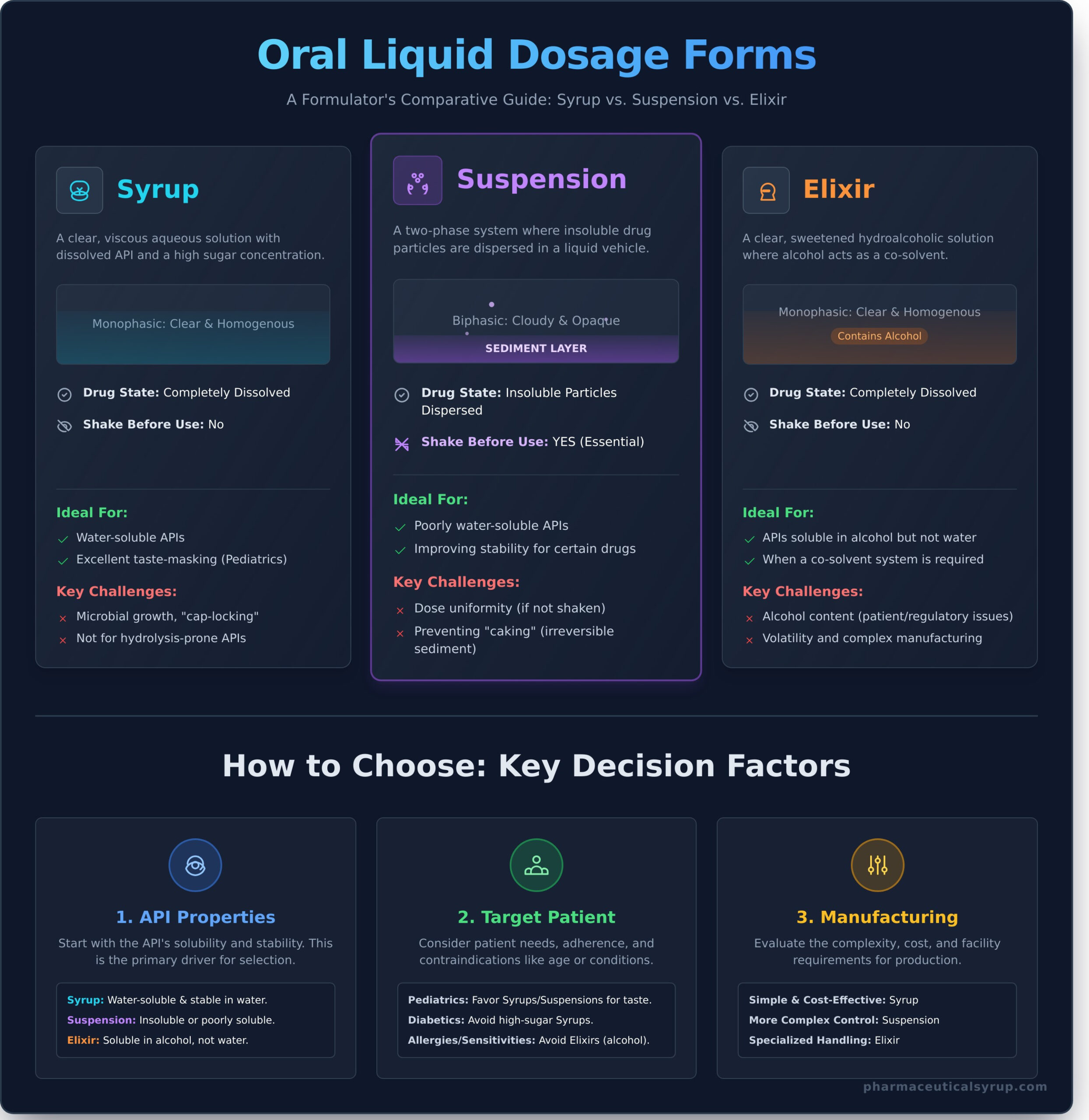
At a Glance: Key Differences Between Syrups, Suspensions, and Elixirs
Before diving into the specifics, this summary table offers a quick comparison of the three primary oral liquid forms.
| Characteristic | Syrup | Suspension | Elixir |
|---|---|---|---|
| Drug State | Completely dissolved (monophasic) | Insoluble particles dispersed (biphasic) | Completely dissolved (monophasic) |
| Appearance | Clear, homogenous | Cloudy, opaque | Clear, homogenous |
| Key Vehicle | Aqueous sugar solution | Aqueous or non-aqueous liquid | Hydroalcoholic solution (water + alcohol) |
| Need to Shake | No | Yes, essential for dose uniformity | No |
| Primary Stability Concern | Microbial growth, crystallization | Caking, crystal growth, non-uniformity | Volatility of alcohol, precipitation |
Deep Dive: Pharmaceutical Syrups
A pharmaceutical syrup is a concentrated, viscous aqueous solution of a sugar, typically sucrose, containing a fully dissolved API. This creates a single-phase, homogenous liquid that is clear in appearance and often has a sweet, palatable taste, making it an excellent choice for masking unpleasant drug flavors.
When to Choose a Syrup Formulation
Syrups are the preferred dosage form under several conditions. They are ideal for water-soluble active ingredients, as the aqueous vehicle allows for complete dissolution, ensuring dose uniformity in every spoonful. This homogeneity eliminates the need for shaking before use. Furthermore, the high concentration of sugar makes syrups excellent for taste-masking bitter or otherwise unpalatable compounds, a crucial advantage in pediatric and geriatric formulations where patient compliance is paramount.
Common Formulation Challenges with Syrups
Despite their advantages, syrups present unique challenges. The high sugar content creates an environment susceptible to microbial growth, necessitating the inclusion of effective preservatives. Another common issue is “cap-locking,” where sugar crystallizes on the threads of the bottle cap, making it difficult to open. Most importantly, syrups are not suitable for APIs that are prone to hydrolysis, as the aqueous environment can cause the drug to degrade over time, reducing its efficacy and shelf life.
Understanding Pharmaceutical Suspensions
A suspension is a two-phase system where finely divided, insoluble drug particles are uniformly dispersed throughout a liquid vehicle. The appearance is typically cloudy or opaque, and because the particles will settle over time (sedimentation), it is critical to shake the container well before each use to ensure a consistent dose.
The Go-To Choice for Insoluble APIs
Suspensions are the perfect solution for drugs with poor water solubility. Instead of forcing dissolution, this formulation embraces the API’s nature by dispersing it. This approach can also enhance the chemical stability of certain APIs that are unstable in solution. Suspensions also offer significant flexibility in taste and flavor formulation, as the drug is not dissolved, making it easier to mask its inherent taste compared to a fully dissolved API.
Key Challenges in Suspension Formulation
The primary challenge with suspensions is ensuring dose uniformity. If the patient forgets to shake the bottle, they may receive an under-dose or overdose. Formulators must also prevent “caking,” a phenomenon where settled particles form a hard, irreversible sediment at the bottom of the container. Meticulous control over particle size, viscosity, and the inclusion of suspending agents is essential to create a stable and effective product. Struggling with API solubility? See our techniques.
The Role of Pharmaceutical Elixirs
An elixir is a clear, sweetened hydroalcoholic solution designed for oral use. It contains both water and alcohol, with the alcohol acting as a co-solvent to dissolve components that are not soluble in water alone. This creates a stable, homogenous liquid that does not require shaking.
When Are Elixirs the Right Formulation?
Elixirs are particularly useful for APIs that are soluble in alcohol but not in water. The hydroalcoholic vehicle provides the necessary solvent system to keep the drug in solution. While historically common, their use has declined, but they remain a viable option when a co-solvent system is required to achieve the desired drug concentration and stability.
Modern Objections and Formulation Hurdles
The primary drawback of elixirs is their alcohol content. This is a significant concern for certain patient populations, including children, pregnant women, and individuals with alcohol sensitivity or specific religious objections. Consequently, elixirs face higher regulatory scrutiny than other liquid forms. Additionally, the volatile nature of alcohol requires careful manufacturing and packaging considerations to prevent evaporation and changes in drug concentration.
How to Choose: A Formulator’s Decision Guide
Selecting the right liquid dosage form is a strategic decision that requires balancing the physicochemical properties of the API with patient needs, regulatory requirements, and manufacturing capabilities.
Factor 1: API Solubility and Stability
The API’s properties are the most critical starting point. If your API is water-soluble and stable in an aqueous environment, a syrup is a strong and straightforward candidate. For an insoluble or poorly soluble API, a suspension is the logical choice. If the API requires a co-solvent system for dissolution and stability, an elixir may be an option, though its drawbacks must be carefully considered.
Factor 2: Target Patient Population
Consider who will be taking the medication. For pediatrics, effective taste-masking is crucial, making syrups and suspensions highly favorable. For geriatric patients, ease of swallowing is a benefit, but high sugar content in syrups may be a concern for diabetic individuals. Elixirs should generally be avoided for any patient group with contraindications to alcohol.
Factor 3: Manufacturing and Cost Implications
The complexity and cost of production also play a role. Syrups are generally simpler and more cost-effective to manufacture on a large scale. Suspensions are more complex, requiring precise control over particle size distribution and viscosity to ensure product quality. Elixirs may require specialized, explosion-proof handling facilities due to the alcohol content, potentially increasing manufacturing costs. Partner with experts for your liquid formulation.
Frequently Asked Questions
What is the main difference between a syrup and a solution?
While all syrups are solutions, not all solutions are syrups. A syrup is a specific type of oral solution that uses a high concentration of sugar (like sucrose) as its primary solvent or vehicle, making it viscous and sweet. A general “solution” can use other solvents and may not be sweetened.
Why is ‘shake well before use’ so important for suspensions?
In a suspension, the solid drug particles settle to the bottom over time. Shaking vigorously redisperses these particles uniformly throughout the liquid. If not shaken, the first doses from the bottle will have too little medication, and the last doses will have too much, leading to ineffective treatment or potential overdose.
Can you formulate a sugar-free syrup?
Yes. For patients who need to limit sugar intake, such as diabetics, syrups can be formulated with sugar substitutes like sorbitol, xylitol, or sucralose. These are often called “syrups” for consistency, but are technically referred to as sweetened oral solutions.
What are the common excipients used in these liquid forms?
Common excipients include solvents (purified water, alcohol), sweeteners (sucrose, sorbitol), preservatives (sodium benzoate, parabens), viscosity modifiers and suspending agents (xanthan gum, cellulose derivatives), flavoring agents, and coloring agents to improve palatability and appearance.
How does the choice of dosage form impact bioavailability?
Generally, drugs in a dissolved state (syrups, elixirs) are more readily absorbed than those in a suspension, as the API doesn’t need to dissolve in the GI tract first. However, for suspensions, controlling the particle size to a very fine level can significantly increase the surface area and dissolution rate, leading to excellent bioavailability.
Choosing the correct oral liquid dosage form is a foundational step in successful drug development. By carefully evaluating your API’s characteristics against the distinct advantages and challenges of syrups, suspensions, and elixirs, you can create a product that is stable, effective, and patient-friendly. If you are facing complex formulation challenges, partnering with an experienced development and manufacturing organization can provide the expertise needed to bring your product to market efficiently. Discuss your oral liquid formulation project with our experts.

