The pharmaceutical landscape is undergoing a profound transformation, driven by innovations that are redefining how therapies are developed, administered, and experienced by patients. Discover the key innovations in drug delivery, from nanotechnology to patient-centric design, and understand how they are revolutionizing treatment and creating new opportunities for more effective and targeted medicines.
The New Paradigm: Key Trends Redefining Drug Delivery
The era of one-size-fits-all medicine is fading. Today, drug delivery is evolving far beyond the traditional pill, with a strategic focus shifting towards enhancing therapeutic efficacy, improving the patient experience, and enabling greater personalization. These powerful trends are not just theoretical; they impact every stage of the pharmaceutical lifecycle, from early-stage research and development to commercial-scale manufacturing and patient support.
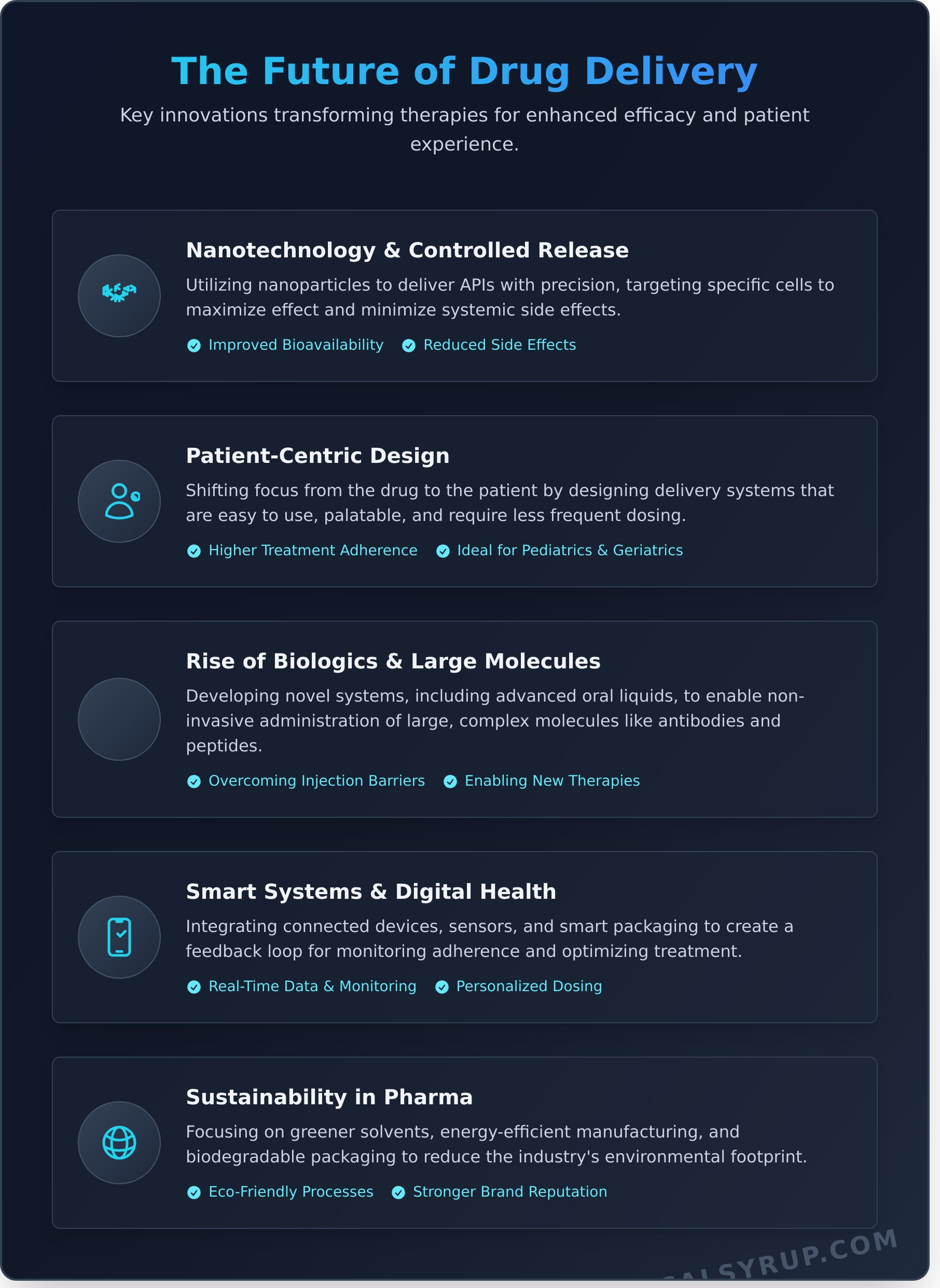
1. Nanotechnology for Targeted and Controlled Release
Nanotechnology has moved from a futuristic concept to a cornerstone of modern drug formulation. By utilizing nanoparticles such as liposomes, micelles, and polymeric carriers, scientists can deliver active pharmaceutical ingredients (APIs) with unprecedented precision. This approach significantly improves the solubility and bioavailability of poorly-absorbed drugs, allowing for more effective treatment. Furthermore, nanoparticles can be engineered to target specific cells or tissues, concentrating the drug’s effect where it’s needed most and dramatically reducing systemic side effects. A practical example is the use of nanoparticles in advanced oral suspensions to ensure better, more consistent absorption in the gastrointestinal tract.
2. Patient-Centricity and Human-Centered Design
The focus is no longer solely on the drug, but on the person taking it. Patient-centricity involves designing drugs and delivery devices around the real-world needs and preferences of patients. This means prioritizing ease of use, reducing the frequency of dosing, and improving palatability to boost adherence. This approach is especially crucial for pediatric and geriatric populations, where challenges with swallowing pills or unpleasant tastes can compromise treatment effectiveness. Oral liquid formulations, like syrups and suspensions, are a prime example of patient-centric design, offering flexible dosing and a more acceptable alternative to solid dosage forms.
3. The Rise of Biologics and Large Molecule Delivery
The therapeutic pipeline is increasingly dominated by biologics, including monoclonal antibodies, peptides, and advanced RNA-based therapies. While incredibly effective, these large molecules present significant delivery challenges, as they are traditionally administered via injection due to degradation in the digestive system. This reliance on injections can create barriers to patient adherence. Consequently, a major area of innovation is the exploration of novel delivery systems—including advanced oral formulations—that can protect these delicate molecules and enable non-invasive administration.
4. Smart Systems and Digital Health Integration
The digital revolution has arrived in drug delivery. Connected devices like smart inhalers, auto-injectors with embedded sensors, and mobile apps are creating a feedback loop between patients and healthcare providers. These technologies can track adherence, monitor physiological responses, and provide real-time data to optimize treatment outcomes. This trend extends to traditional dosage forms as well; for instance, smart packaging for oral liquids, such as caps that record dosing times, can significantly improve accuracy and adherence for patients and caregivers.
5. Sustainability in Drug Development and Manufacturing
The pharmaceutical industry is facing increasing pressure to reduce its environmental footprint. Sustainability is becoming a key driver in formulation and manufacturing decisions. This trend includes a focus on using greener solvents, designing more energy-efficient production processes, and developing biodegradable packaging and delivery devices. Companies that embrace sustainable practices not only contribute to environmental protection but also build a stronger brand reputation among consumers and stakeholders.
How These Trends Impact Oral Liquid Formulations
Oral liquids, such as syrups and suspensions, are uniquely positioned to capitalize on these patient-centric trends. Once viewed as a simple alternative to tablets, modern oral liquid formulations are now at the forefront of innovation, as technology helps overcome traditional challenges related to stability, bioavailability, and taste.
Enhancing Bioavailability in Syrups and Suspensions
Modern formulation science is transforming what’s possible with oral liquids. The use of nano-suspensions can dramatically improve the absorption of poorly soluble drugs, making them more effective at lower doses. Additionally, advanced excipients can be used to create protective micro-environments for APIs, shielding them from degradation in the harsh conditions of the gut. These innovations lead directly to better patient outcomes through lower required doses and fewer potential side effects.
Improving Adherence Through Better Formulations
Patient adherence is a critical factor in treatment success. Advanced taste-masking technologies are essential for making pediatric and geriatric syrups more palatable and acceptable. Furthermore, packaging innovations like single-dose vials or sachets improve convenience, eliminate the risk of dosing errors, and are ideal for patients on the go. Oral liquids inherently allow for the flexible, weight-based dosing that is often required for children and the elderly—a level of personalization that is difficult to achieve with fixed-dose tablets.
The Future: Smart Syrups and Personalized Dosing
The convergence of technology and formulation science points to an exciting future. Imagine intelligent bottle caps that track and log every dose, sending reminders to a patient’s smartphone. Artificial intelligence is already being used to accelerate the development of highly stable and palatable formulations. By connecting liquid formulations to digital health platforms, it becomes possible to enable remote monitoring and personalized dosing adjustments. If you are facing a complex formulation challenge and want to explore what’s next, see how we can help.
Frequently Asked Questions
What is the most significant trend in drug delivery right now?
While all the trends are impactful, patient-centricity is arguably the most significant as it acts as an umbrella for many other innovations. The drive to make medicine easier, safer, and more effective for the individual is fueling advancements in everything from nanotechnology to digital health integration.
How does nanotechnology work in a drug formulation?
In drug formulation, nanotechnology involves encapsulating an active pharmaceutical ingredient (API) within a tiny carrier, often a nanoparticle. This carrier protects the API from degradation, helps it dissolve in the body, and can be designed to release the drug at a specific site or over a prolonged period, enhancing its effectiveness and reducing side effects.
Are oral liquids becoming more important than tablets?
Oral liquids are not replacing tablets, but their importance is growing significantly. They are the preferred dosage form for key patient groups like children and the elderly. Furthermore, advancements in formulation science are making them a viable and sophisticated delivery system for a wider range of complex drugs, especially where flexible dosing and rapid onset are needed.
What is patient-centric drug design?
Patient-centric drug design is an approach that puts the needs, preferences, and limitations of the patient at the center of the development process. It considers factors like ease of swallowing, taste, dosing frequency, and convenience of administration to create a product that patients are more likely to use correctly and consistently.
How can drug delivery systems be made more sustainable?
Sustainability can be integrated into drug delivery by choosing biodegradable materials for devices and packaging, optimizing manufacturing processes to reduce waste and energy consumption, and using greener solvents and excipients in formulations. The goal is to minimize the environmental impact throughout the product’s lifecycle.
Navigating the future of pharmaceuticals requires a partner with deep expertise in complex oral liquid formulations and a commitment to innovation. With state-of-the-art GMP-compliant manufacturing facilities and a team of specialists in pediatric and geriatric drug development, we are ready to tackle your toughest challenges. Let’s formulate the future of your oral liquid drug together. Contact us.